


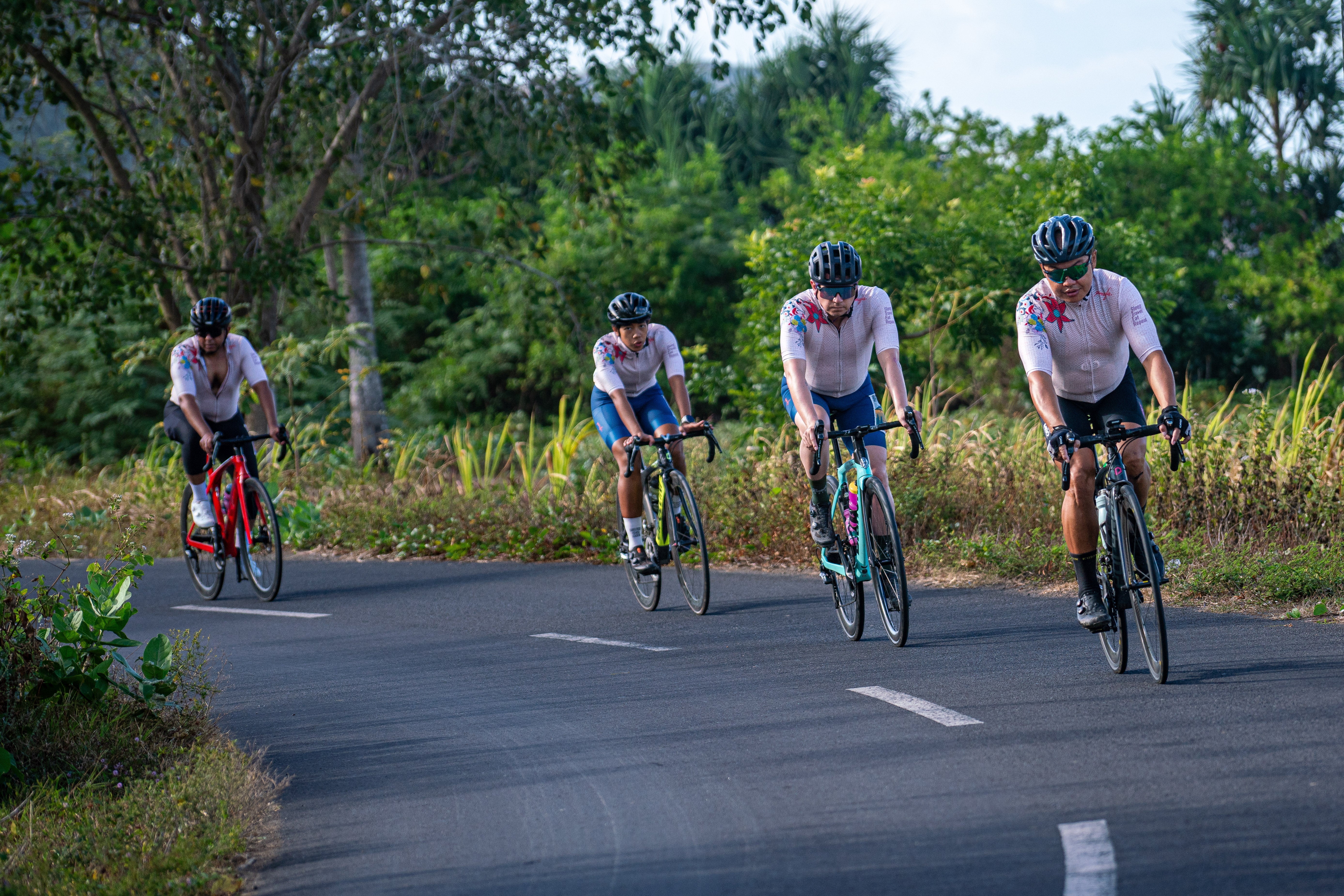


There's a moment on every budget cycling tour when the math becomes impossible to ignore. Twenty-four riders, one guide, a support van that left with the luggage two hours ago, and a puncture on the wrong side of a mountain. You wait. Someone grumbles. Someone else checks their Strava and realizes the group pace dropped to 13 km/h three hours ago. The guide radios for help that's 45 minutes away.
That moment doesn't happen on a boutique tour. Not because boutique operators try harder — though they do — but because the math works in the other direction from the start. Here's what the price difference actually translates to, and why Bali in particular exposes every weakness of the budget model.
What "Boutique" Actually Means on a Cycling Tour
The word gets thrown around until it's meaningless, so let's pin it down. A boutique cycling tour is defined by three numbers: group size, support ratio, and bike quality.
Group size. Boutique means 8 to 14 riders, never 20-plus. On Bali's roads — narrow, winding, shared with scooters and ceremony traffic — a small group is the difference between flowing through a village as welcomed guests and clogging it as an inconvenience. Budget operators maximize headcount; boutique operators cap it. The economics are simple: fewer riders per departure means higher cost per rider, but it also means the group moves at the pace of its riders, not its slowest logistics.
Support ratio. A boutique tour runs a guide-to-rider ratio of 1:6 or better. On Qunafa's Bali voyage, that means two experienced guides, a support vehicle that shadows the route rather than racing ahead, and a mechanic who can fix a broken spoke at a roadside temple without anyone unpacking a multi-tool. Budget tours assign one guide to 20 riders and call it "independence."
Bike quality. This is where the gap widens most sharply. Budget tours supply aluminum hybrids with rim brakes and a saddle that feels borrowed from a gym spin bike. Boutique tours put you on titanium — a Shahrazad frame that absorbs Bali's road chatter for seven hours without leaving your hands numb. The bike isn't a line item; it's the entire experience. A $400 rental bike and a $6,500 titanium machine deliver fundamentally different days in the saddle.
What the Budget Price Tag Doesn't Include
A $1,500 Bali cycling tour looks cheaper on the booking page. It is not cheaper. Here's what those operators don't itemize:
Accommodation you'd actually book yourself. Budget tours use guesthouses 30 minutes from the route start, chosen for per-night cost, not location or quality. Boutique operators place you in villas and boutique hotels that sit on the route itself. You roll out of bed onto the bike. That's not a luxury detail — it's two extra hours of riding before the heat builds, every day.
Food that fuels the ride. A budget tour's included meals are warung buffet lines: filling, fine for a day, but six days of nasi goreng and you'll feel it on the climbs. Boutique tours build restaurant-quality meals into the itinerary — including stops at kitchens that don't serve groups, because a table for ten works at places a table for twenty-four never could.
Routes budget tours can't access. Many of Bali's best cycling roads are single-lane paths through rice terraces, temple precincts, and village backroads. A group of 24 simply doesn't fit. A group of 10 does. The boutique premium purchases access to routes the budget model excludes by its own economics.
The bike that doesn't ruin your week. We've covered this, but it bears repeating: the cost difference between a titanium frame with electronic shifting and an aluminum hybrid with mechanical brakes is roughly $6,000 at retail. Over six days of Bali's mixed terrain — paved coastal roads, broken inland asphalt, the occasional gravel connector — the titanium bike isn't a luxury. It's the reason you still want to ride on day six.
Bali Specifically Demands Boutique
Bali isn't Mallorca. It doesn't have wide, freshly-paved cycling highways with driver awareness campaigns and bike-friendly cafés every ten kilometers. Bali's cycling infrastructure is the road itself — and the road is shared with everything from ceremonial processions to trucks carrying temple stones.
This matters because the budget model — large groups, minimal support, generic equipment — was designed for Europe's cycling infrastructure, not Southeast Asia's. In Bali, the boutique advantages become non-negotiable:
- **Route knowledge that can't be Googled.** Bali's best cycling roads aren't on Komoot. They're the connectors known to local riders — the back way into Sidemen that avoids the truck route, the temple road that's open to cyclists but closed to vans. A budget guide working their third season doesn't know these. A boutique operator who lives on the island does.
- **Cultural navigation.** Temple ceremonies close roads without warning. Offerings in the lane require a specific protocol to pass respectfully. A boutique guide — an Indonesian rider who grew up with these rhythms — navigates this instinctively. A rotating cast of budget guides might not.
- **Recovery that matches the climate.** Bali's equatorial heat and humidity extract a toll that Mallorca's Mediterranean breeze doesn't. Boutique itineraries build in recovery: midday pool breaks, massage availability, hydration protocols. Budget tours push through on schedule because schedule is all they have.
What $5,500 Actually Buys
Let's be direct. A Qunafa Bali voyage costs $5,500 per rider. That's not a number to hide behind "contact us for pricing." It's the price, and here's what it covers over ten nights:
A titanium Shahrazad bike fitted to your measurements before you land. Eleven days of curated routes designed by riders who've been cycling Bali for years, not months. Accommodation in hand-selected villas and boutique hotels on the route — not near it. All meals, from pre-ride breakfast through post-ride dinner, at restaurants chosen for quality, not group capacity. Two dedicated guides, a support vehicle, and a mechanic. Cultural stops — temple visits, artisan workshops, Sasak weaving demonstrations in Lombok — that aren't tourist traps because a group of ten can go where tour buses can't. Airport transfers, luggage handling, and every logistical detail handled.
The budget tour charges $1,500 and leaves you solving every problem it creates. The boutique tour charges $5,500 and eliminates problems before you notice them. One is a transaction. The other is a voyage.
Ready to see the difference? 19 seats remain on the July 22 Bali & Lombok voyage — the only boutique crossing of its kind. See the full itinerary → qunafa.travel/bali
← [[🏠-DASHBOARD|Dashboard]]
Related reads: solo vs group cycling in Bali · a day on a Qunafa Bali tour