


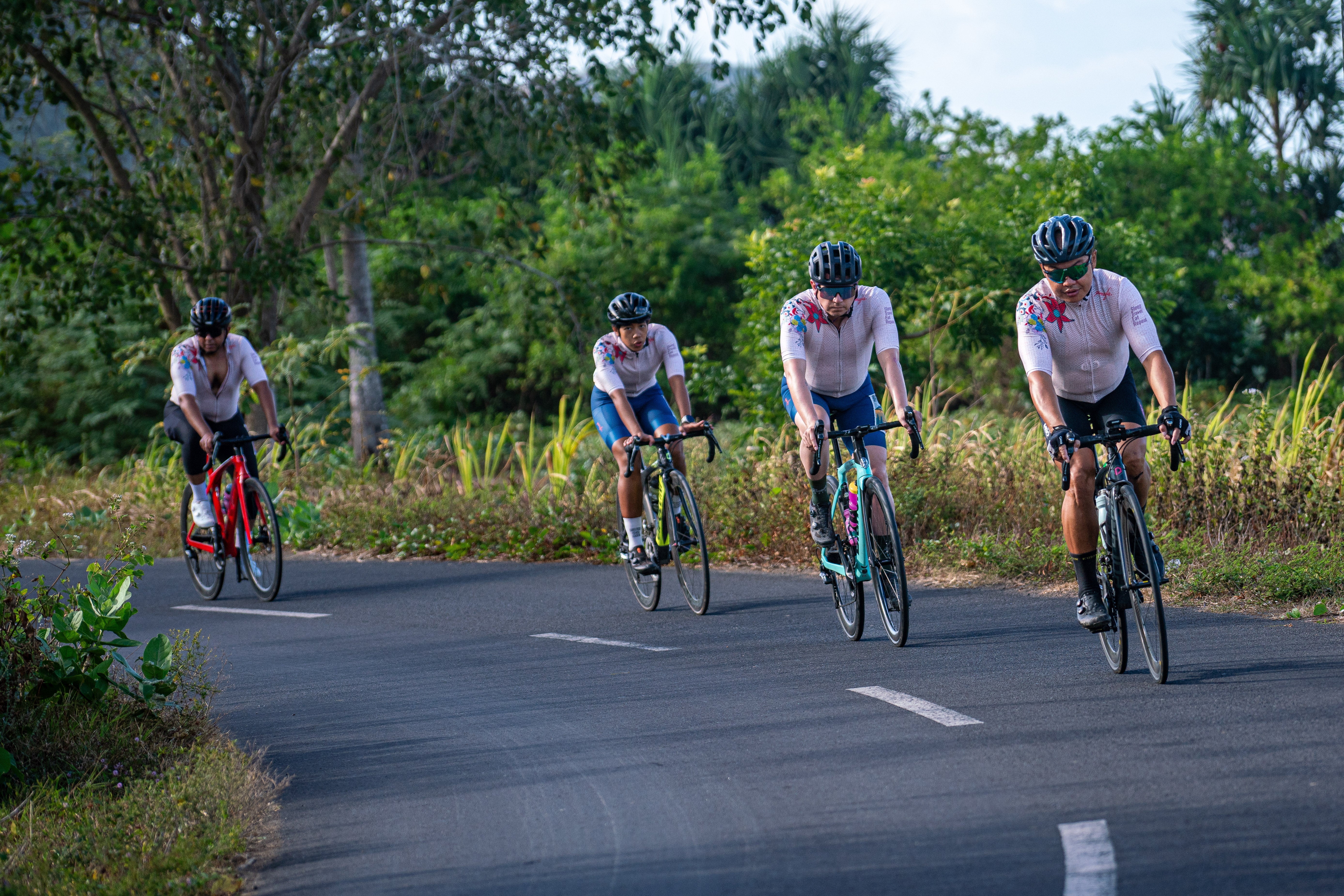


There are climbs that test your legs and climbs that rearrange something deeper. The road up Mount Agung does both. At 3,031 metres, it's Bali's highest peak and an active volcano whose slopes have been sacred to Balinese Hindus for over a thousand years.
The road doesn't go to the summit — it stops at Pasar Agung Temple, 1,600 metres up, a place where cyclists and pilgrims share the same pavement. But what the road lacks in altitude it makes up in character: 8.5 kilometres, over 1,000 metres of elevation gain, and an average gradient of 12% that hides ramps touching 20% when you're already five kilometres deep and bargaining with your cassette.
This is not a climb you ride for a PR. You ride it for the story.

The Road Itself: What 8.5 Kilometres of Agung Feels Like
The climb starts from Selat, a market town on Agung's southeastern flank where the air is already thick with humidity and the smell of clove cigarettes. You roll out past warungs and motorcycle repair shops, and within 500 metres the road tilts upward without ceremony. There is no warm-up — just a decision: are you doing this or not?
The first three kilometres are the truth-teller. Gradients hover between 10% and 14%, and the road surface alternates between smooth tarmac and patched sections where the volcanic substrate underneath has buckled the asphalt. You'll want a compact crankset (50/34 minimum) and a cassette that goes to at least 32 teeth. The sequence of steep ramps saps both strength and morale, separated by all-too-short sections of respite. That's accurate.
Kilometres four through six are where the climb earns its reputation. The road narrows to roughly a car and a half wide, hemmed in by jungle on one side and a drop-off on the other. The gradient spikes above 18% on two switchbacks that come in quick succession, and if you've misjudged your pacing, this is where you'll find out. Your Garmin will say you've climbed 700 metres. You'll have just under 300 to go. It will feel like 800.
The final two kilometres ease — and by "ease" we mean 9% to 12% — as the jungle thins and the sky opens. The road flattens briefly at the temple approach, and then you're there: Pasar Agung, the highest temple in Bali, at the literal end of the road. Park your bike against the stone wall. Catch your breath. Look east toward Lombok, where Mount Rinjani rises out of the sea on clear mornings. This is the reward that isn't recorded on Strava.

Why Mount Agung Is Different from Every Other Bucket-List Climb
Most famous cycling climbs are famous because they appear in grand tours. Alpe d'Huez, the Stelvio, Sa Calobra — these are stages, broadcast live, complete with painted names on the road and souvenir shops at the summit. You know exactly what you're getting because thousands of riders have documented every hairpin.
Mount Agung shares none of this infrastructure. There are no kilometre markers. No gift shop. No leaderboard. Just the road, the jungle, and a temple that has been receiving offerings since before paved roads existed on the island.
That absence of cycling infrastructure is the point. Riding Agung feels like discovery, not participation. You're not following someone else's segment — you're navigating a road that exists for the villages on the mountain, for the ceremonies at Pasar Agung, for the pilgrims who climb to the summit on foot at 2am to catch sunrise from the crater rim. When you descend, you'll pass through hamlets where children wave and old women in kebaya carry offerings on their heads. Nobody particularly cares that you're on a bike. The mountain is the main character. You're just passing through.
The cultural layer compounds the physical one. Pasar Agung Temple is one of Bali's nine directional temples, built to honour the gods of the mountain. On auspicious days — and there are many in the Balinese calendar — the climb is closed to everyone except worshippers. If you're planning to ride Agung, check the ceremonial calendar with a local guide or your tour operator. Showing up on a closed day isn't just a disappointment; it's disrespectful. The mountain is holy first, rideable second. That hierarchy is worth remembering.
How to Ride Mount Agung (and Come Back with the Story)
When to go. The dry season — April through mid-October — is the window. July and August offer the most reliable visibility and the lowest chance of afternoon rain turning the descent into a slick, dangerous mess. Start your climb by 6:30am at the latest. By 10am, the tropical sun turns the exposed upper section into an oven, and the humidity in the lower jungle makes breathing feel like work.
What to bring. Two full bottles minimum — there is no water on the climb. A vest or light wind layer for the descent; you'll be sweating at the temple and freezing by the time you hit Selat if you don't cover up. Sunscreen reapplied at the temple. Cash (IDR) for the warung at the bottom — you will want a cold drink and something fried when you're done.
What to expect from your legs. If you regularly ride 1,000-metre climbs — a Solidago loop, a Tramuntana day, a proper Dolomites pass — you have the fitness. The difference is the gradient, not the total ascent. Agung doesn't let you settle into a rhythm. You're either climbing hard or recovering briefly, and the humidity amplifies perceived effort by roughly 15–20% compared to the same gradient in dry European air. Bring low gearing, pace the first three kilometres conservatively, and treat the final temple approach as a cooldown, not a sprint.
The descent. Take it slow. The road surface isn't consistent, and the switchbacks that felt impossibly steep on the way up are blind on the way down. A scooter carrying a family of four can appear mid-corner without warning. Enjoy the ride — the views open up dramatically on the lower half — but keep your hands on the brakes and your ego in check.
Riding Bali this year? The Qunafa Archipelago Ascent runs July 22 — ten nights from Lombok to Bali, fully supported, with Mount Agung's slopes on the route. A limited number of seats remain →
More Bali reading: Best Time to Cycle Bali · 7 Hidden Gems Beyond Ubud · Complete Packing Guide
Related reads: hidden Bali cycling routes · best time to cycle Bali