


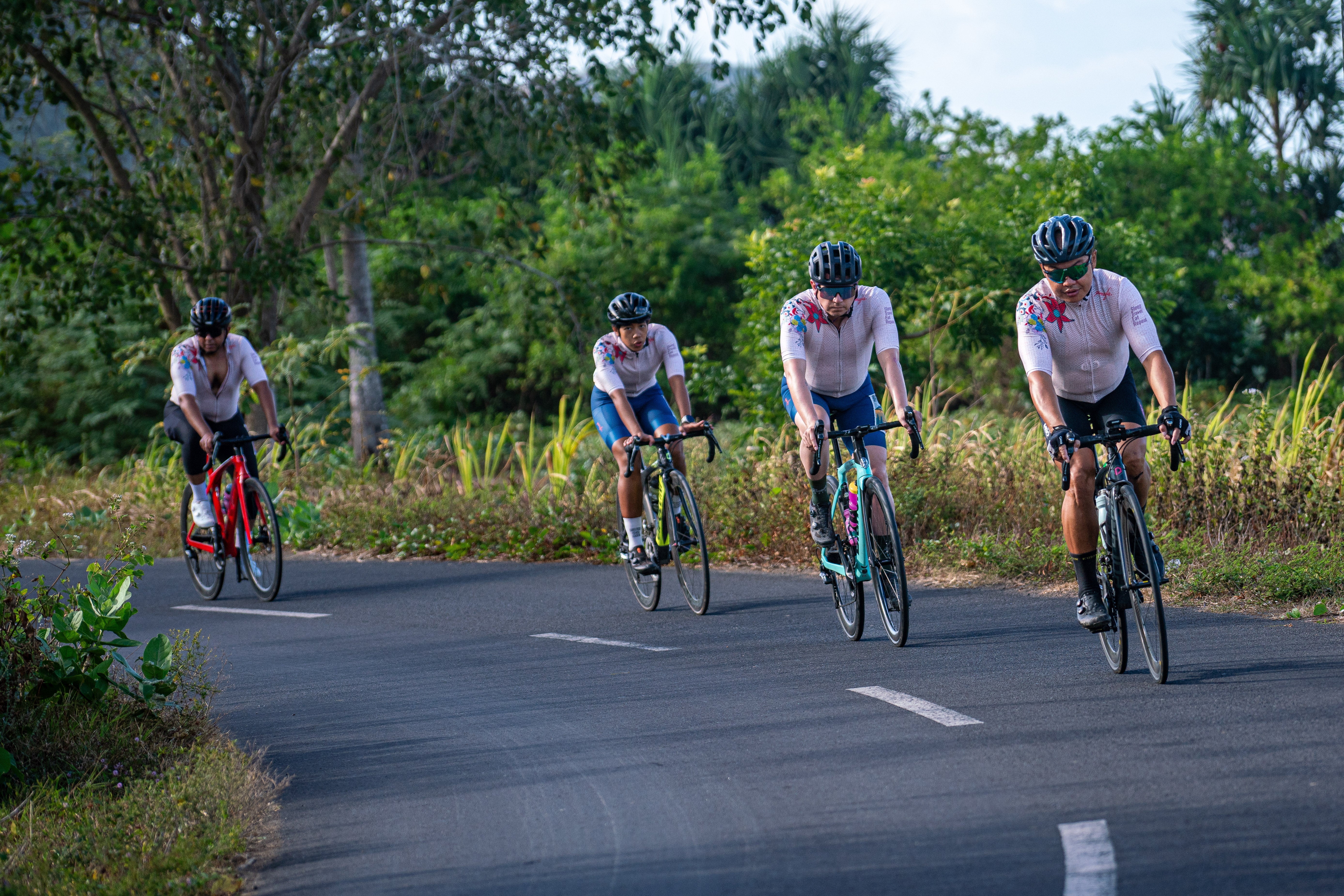


Most cyclists land in Bali with a route map, a Garmin file, and a list of climbs. What they don't bring is an understanding that the road they're about to ride is, very likely, also a pilgrimage path. The temple they pass at kilometre 22 isn't a scenic backdrop — it's an active site of worship that has received daily offerings for centuries. The incense they smell on the morning descent isn't for tourists — it's part of a religious rhythm that predates paved roads by roughly a thousand years.
Bali has over 20,000 temples. Some of the island's most famous cycling routes — the Sidemen Valley, the Kintamani descent, the Mount Agung approach — thread directly through temple lands, past village shrines, and along roads that close without notice for ceremonies. Riding here without understanding the cultural layer isn't just a missed opportunity. It's the difference between passing through and actually arriving.
Temples on two wheels: where the road meets the sacred
Not every temple you pass is the same, and knowing the difference changes how you ride. Bali's temples are organized in a hierarchy that maps directly onto the landscape you're cycling through. The Pura Kahyangan Jagad — directional temples — are the most important: nine of them, positioned at cardinal points across the island, including Pasar Agung Temple on Mount Agung and Luhur Uluwatu on the southern cliffs. If you ride Agung's 8.5 km climb, you're pedalling toward one of Bali's most sacred sites. The road doesn't go to the summit; it stops at the temple, because the temple is the destination.
Village temples — Pura Desa, Pura Puseh, Pura Dalem — are the ones you'll encounter most often on rural routes through Sidemen, Tabanan, and Bangli. These are functioning religious centres, not museums. On any given morning, a Pura Desa might be hosting a tooth-filing ceremony, a wedding blessing, or a cremation procession. If you see a penjor — a tall, decorated bamboo pole arched over a gate — a ceremony is either recent or imminent. The correct response is to slow down, read the atmosphere, and if the gate is open but a ceremony is visibly in progress, keep moving. Don't roll through a wedding uninvited.
Practical notes for cyclists passing temples:
- Sarong and sash are required for entry at all temples. A lightweight sarong folds into a jersey pocket. Most temple entrances rent them for a few thousand rupiah if you arrive unprepared.
- Never step over offerings on the ground, and never position your bike so the wheels point toward a shrine.
- Ceremonial calendar closures happen without online warning. A road you rode yesterday might be closed today for Odalan — a temple's anniversary ceremony, which occurs every 210 days on the Balinese Pawukon calendar. Local knowledge is the only way to know. This is where a guided tour with Balinese support stops being a luxury and starts being a practical necessity.
Canang sari and the morning roads: riding through daily Bali
The first thing you'll see if you start riding at sunrise — which, in Bali, you should — is women in kebaya placing small woven-palm baskets on the ground in front of homes, shops, and shrines. These are canang sari: daily offerings made from a base of coconut leaves, filled with flowers, a sliver of pandan, sometimes a biscuit or a cigarette, always with a stick of burning incense. They are placed three times daily in some households: morning, midday, and late afternoon. By the time you clip in at 6:30am, thousands of them are already on the streets.
As a cyclist, the rule is simple and absolute: you do not ride over them. It doesn't matter if the offering is on a driveway, a sidewalk, or — as happens — directly in the bike lane. It doesn't matter if you're chasing a PR on a segment. You brake, you stop, you lift your bike around it, or you wait. This is the single easiest cultural misstep a foreign cyclist can make in Bali, and local riders will notice.
The practical consequence for your riding is that morning starts are punctuated by micro-stops. They're not interruptions — they're part of the texture. The smell of sandalwood incense on a descent through terraced rice fields at 7am, the brief pause as a woman in a flower-printed kebaya places an offering at a gate and meets your eyes with a smile — these are not things you get on an Alpe d'Huez segment.
Offering practices scale up dramatically during major holidays. Galungan, which occurs every 210 days, sees penjor lining every road and larger banten offerings — towering arrangements of fruit, rice cakes, and flowers — placed at village crossroads and temple gates. On Nyepi, the Balinese Day of Silence, the entire island shuts down for 24 hours: no flights, no traffic, no outdoor activity. You cannot ride on Nyepi. If your tour dates overlap with it, you're spending the day indoors, in the dark (no lights are permitted visible from outside), and in silence. It's extraordinary — but you need to know it's coming.
The unwritten etiquette: what your guide knows that Google doesn't
If you're riding Bali solo, your biggest vulnerability isn't physical — it's cultural. Strava doesn't mark temple closures. RideWithGPS won't tell you that the road through Bangli has a ceremony procession at 10am. Google Maps labels a route as a secondary road without mentioning it doubles as a pilgrimage path on full moons.
A handful of protocols that matter:
- **Dress for stops, not just the ride.** Temples require covered shoulders and knees. Sarongs can be rented at major temples, but village shrines and smaller pura rarely have rental booths. Carry one.
- **Don't photograph ceremonies from above.** Standing higher than a priest during a ritual — even unintentionally, from a roadside elevated angle — is considered disrespectful. Shoot from eye level or lower. Never use flash during ceremonies.
- **Offerings on the road are not decorations.** Don't touch them, don't move them, don't photograph them with your bike placed next to them for "authenticity." The shot isn't worth what it communicates.
- **Melukat (water blessings) are religious acts.** If you're invited to participate in a purification ritual at Tirta Empul or a village temple, it's real worship, not a tourist experience. Accept respectfully or decline gracefully. Don't treat it as an Instagram story.
What changes when you're riding with local guides is that none of this is guesswork. Qunafa's Bali routes are built with local knowledge — the guide knows which village has an Odalan this week, which road narrows during morning market hours, which temple gate requires a sarong and which one you can pass without stopping. You ride more and worry less, and what you absorb culturally isn't filtered through a language barrier. Your guide translates the thing you just saw — the penjor at the junction, the banten at the bridge, the priest crossing the road in white — into context you can carry home.
Riding Bali this year? The Qunafa Archipelago Ascent runs July 22 — ten nights from Lombok to Bali, fully supported, with local Balinese guides who know every temple, offering stop, and ceremony along the route. **19 seats remain on July 22 → qunafa.travel/bali**
*More Bali reading: Best Time to Cycle Bali · 7 Hidden Gems Beyond Ubud · Complete Packing Checklist*
← [[🏠-DASHBOARD|Dashboard]]
Related reads: Bali cycling routes · solo vs group cycling in Bali