

Every few months someone asks us the same question, usually over coffee, usually while running a hand along a frame: "If titanium is so good, why didn't it ever win the Tour de France?"
It's a fair question. We asked it ourselves in 2020.
That was the year we pivoted to bikes. We tried around twenty brands, steel and carbon and everything between, looking for the one we'd be proud to put our guests on. Titanium kept pulling us back. And the Tour question kept nagging at us.
The Tour rewards a different kind of bike
The Tour de France is a three-week argument about who can go fastest on the worst day. Teams chase marginal gains: a few grams here, a little more stiffness there, a bike built for a single rider's single purpose. When the goal is to win a stage, you build for the stage.
Carbon fiber suits that world. It can be molded into almost any shape and tuned for stiffness in one direction and flex in another. It is the right material for a team with a mechanic, a spare bike on the roof, and a sponsor who replaces the frame every season.
That's a very particular kind of customer. Almost nobody reading this is that customer, and that includes us.
Racing isn't riding
Here's what the peloton doesn't tell you: a race bike is built to be ridden hard for a few hours and then retired. Nobody designs it to be loved for fifteen years.
Think about what you want from your own bike. You want to roll out of the hotel on day three of a trip and feel fine. You want to roll over a broken Sicilian road without your hands going numb. You want a frame that still feels like yours after ten thousand miles.
That's not what a Tour bike is for. It's what titanium is for.
What titanium does differently
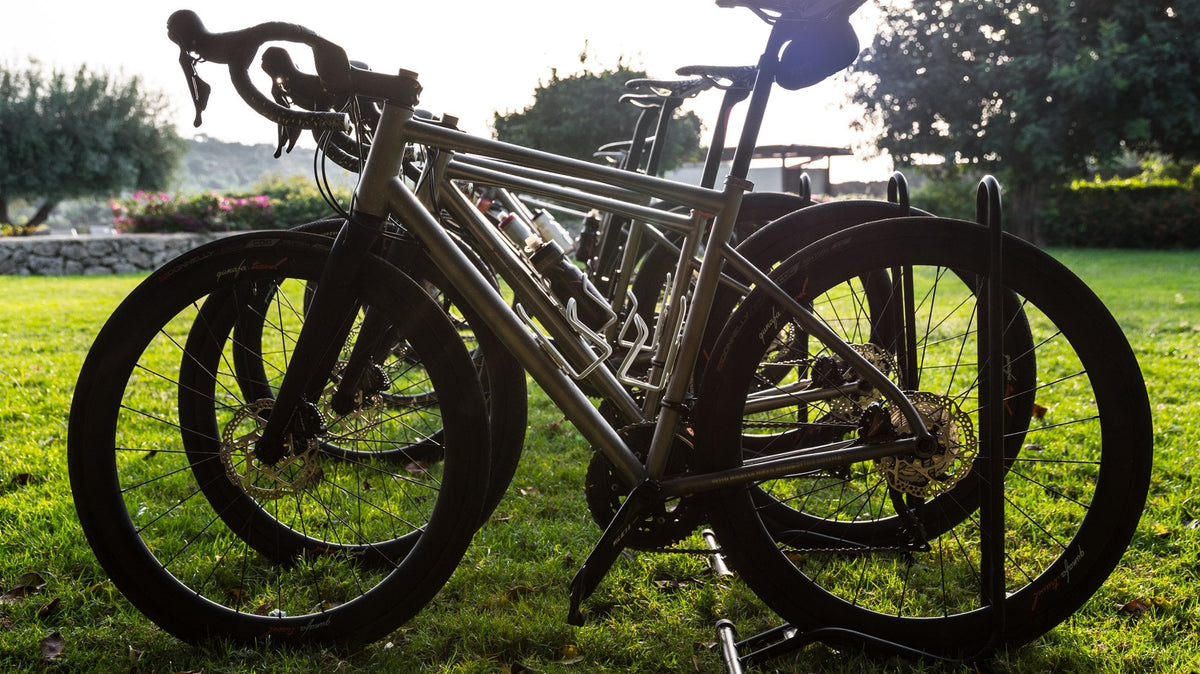
We say this on every ride, so we'll say it here too: a good titanium frame has the snap of a race bike with the comfort of an endurance frame.
You feel it most in the second half of a long day. A stiff, twitchy bike gives you everything in the first hour and takes it back by hour five. Titanium has a quiet, springy give. It doesn't rattle your teeth, but it still jumps when you stand on the pedals. We've watched guests get off after a long day in the saddle and say the same thing: "I thought I'd be more tired."
Titanium also doesn't rust, doesn't fear a scratch, and doesn't need to be babied. Put a titanium frame in the back of a van, lean it against a stone wall in a mountain village, and nobody flinches. A carbon race frame lives with a quiet anxiety. Titanium lets you stop thinking about the bike and start thinking about the road.
So why doesn't the peloton ride it?
A few honest reasons, none of them about the ride:
- Racing chases the last gram. Carbon can be shaped and layered to shave weight in a way a welded tube set can't easily match.
- Sponsors sell new bikes every year. A frame built to last decades is bad news for a product cycle. That isn't a flaw in the metal. It's a different business model.
- Pros don't ride for comfort. They're paid to suffer. You aren't.
It just wasn't what the race was asking for.
Where this leaves the rest of us
We think the Tour question is the wrong test. Ask instead: what would you want to be riding in ten years, on a long trip through the mountains, when you're tired, happy and a long way from home?
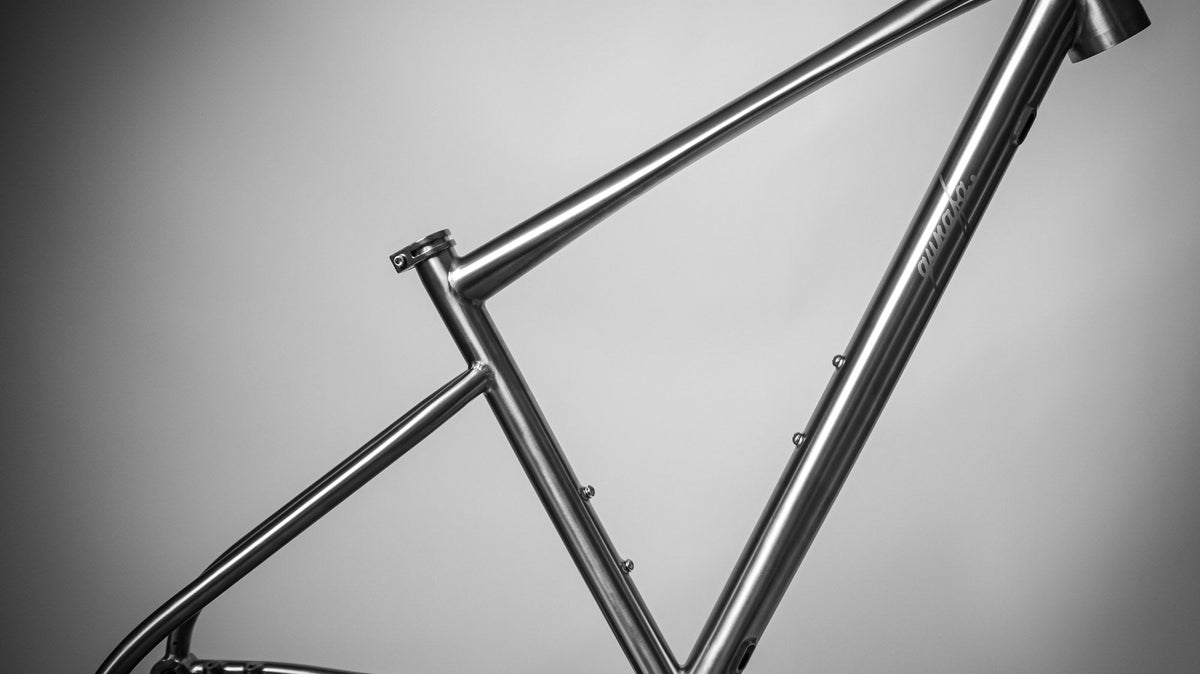
That's the bike we set out to build. Our titanium comes in two forms: classic titanium tubing as the entry point, and 3D-printed titanium for those who want to go further. Two bikes, one metal, zero compromise on the ride.
We built them from the way real riders actually ride, not from what racers need on a single stage. People tell us they like the classic titanium for its balance, and that's the one we point most guests toward.
Come ride one
You don't have to take our word for any of this. A titanium frame is something you have to feel, and the best place to feel it is a long day on a real road.
Or ride with us: see our cycling tours.